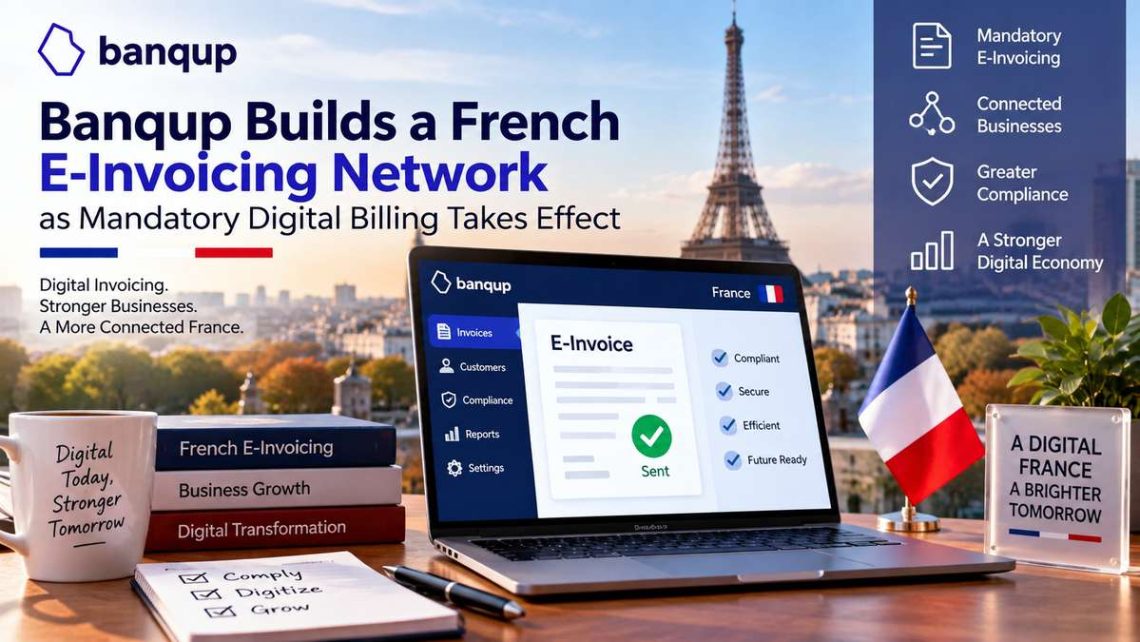
France’s shift toward mandatory electronic invoicing is creating a major opening for financial technology companies, and Banqup is using one of the country’s most trusted business networks to capture that opportunity.
The European fintech company says its French operations have accelerated following the launch of the country’s national e-invoicing rollout, with its partner-led strategy bringing the company’s technology directly into the accounting ecosystem.
At the center of the expansion is jefacture.com, an accredited French e-invoicing platform created by ECMA, the digital arm of France’s National Council of Chartered Accountants. Banqup provides the underlying technology supporting the platform.
The approach is notable because Banqup is not relying primarily on a large direct-sales operation. Instead, it is using accountants as the bridge between its technology and the small and midsize businesses that must adapt to France’s new invoicing rules.
France’s E-Invoicing Deadline Has Changed the Market
The timing is crucial.
France’s electronic invoicing reform entered its first implementation phase on September 1, 2026. Under the new system, businesses will increasingly have to use approved platforms to receive and transmit electronic invoices and provide required transaction data to the tax administration.
That means e-invoicing is no longer simply a technology upgrade that companies can consider when convenient.
For many businesses, compliance is becoming part of normal financial operations.
The result is a rapidly expanding market for platforms that can connect companies, accountants, customers and tax authorities.
Banqup is positioning itself directly in the middle of that transition.
Accountants Are Becoming the Distribution Channel
Banqup’s French strategy is built around a relatively simple idea: businesses already trust their accountants.
Instead of asking thousands of small companies to discover and adopt a new financial platform independently, Banqup works through accounting professionals who can introduce the service to their existing client networks.
According to the company’s latest announcement, almost 175,000 business clients are now registered on the platform, supported through nearly 4,900 chartered accounting firms directing clients toward jefacture.com.
That gives the company something more valuable than a conventional advertising campaign—a distribution network embedded in the daily financial operations of businesses.
Why Small Businesses Matter
The French e-invoicing transition will affect businesses of different sizes, but small and midsize companies are particularly important to technology providers.
Many smaller businesses do not have large finance departments or dedicated technology teams.
Their accountants often handle much of the practical work surrounding tax compliance, bookkeeping and financial administration.
That makes accountants a natural point of contact when new digital requirements arrive.
For Banqup, the partnership model can therefore reduce the friction involved in bringing large numbers of businesses onto its platform.
The Strategy Is Designed to Scale
Banqup describes its partner-led approach as a model it can reproduce in other European markets preparing for mandatory e-invoicing.
The company has previously developed partnerships across accounting and tax services, software, distribution and payments. Its 2025 reporting highlighted partnerships designed to reach small businesses through established professional networks and embedded software solutions.
The logic is straightforward.
Building a direct sales organization in every country can be expensive and time-consuming.
Working with established partners allows a fintech company to tap into networks that already have customers, credibility and local knowledge.
France is now providing a large-scale test of that strategy.
E-Invoicing Could Become the Gateway to More Services
There is another reason Banqup is interested in growing its e-invoicing customer base.
An electronic invoicing platform can become much more than a place to send and receive bills.
Once businesses are connected to a digital financial system, additional services—including payments, transaction management, reporting and other financial tools—can potentially be introduced through the same platform.
Banqup has specifically identified its existing French network as an opportunity to expand the use of other products, including its payment module.
In that sense, e-invoicing can function as the front door to a broader financial operating system.
The French Market Comes at an Important Time for Banqup
The expansion also arrives as Banqup itself is undergoing a broader transformation.
In its first-half 2026 results, the company reported subscription revenue growth of 42.3% year over year to €10.4 million, while annual recurring digital revenue reached €48.2 million at the end of June. Banqup said e-invoicing adoption was an important driver of its digital subscription growth, particularly in Belgium.
The company is simultaneously reorganizing its operations into business units and pursuing strategic alternatives for some businesses or potentially the group as a whole.
That makes the French rollout especially important.
A successful expansion could provide Banqup with another source of recurring digital revenue at a time when the company is seeking to sharpen its focus and improve operational performance.
France Is Only the Beginning
The opportunity extends beyond France.
Banqup says it is also seeing growing demand in Germany ahead of that country’s planned mandatory e-invoicing rollout beginning in 2027. The company has described France and Germany as important markets in its European growth pipeline.
That creates a broader opportunity for companies capable of adapting their platforms to different national compliance systems.
The challenge, however, is that European e-invoicing rules are not identical from one country to another.
A platform needs to understand local tax requirements, data standards, reporting systems and approved infrastructure.
A partner-led approach can help address some of those differences because local accounting and professional networks already understand the domestic environment.
Compliance Is Becoming a Technology Market
France’s experience illustrates a larger change taking place across Europe.
Governments are increasingly using digital systems to make tax reporting faster, more standardized and easier to monitor.
For businesses, that means compliance is becoming increasingly connected to software.
Companies that once exchanged invoices by email, paper or basic accounting systems now need infrastructure capable of meeting formal digital reporting requirements.
That creates opportunities for fintech companies—but it also raises the bar.
Simply offering electronic invoices is no longer enough. Platforms must provide reliability, security, interoperability and regulatory compliance.
The Real Competitive Advantage May Be Trust
Technology will remain important, but Banqup’s French strategy suggests that distribution and trust may be just as valuable.
An unfamiliar fintech brand trying to persuade hundreds of thousands of small businesses to change their invoicing systems faces an obvious challenge: why should a company trust a new provider with such an important part of its financial operations?
An accountant recommending the platform changes that equation.
The relationship already exists.
That makes the accountant-led model particularly suited to markets where regulatory change forces businesses to adopt new technology quickly.
What Comes Next for Banqup
The immediate priority will be to convert France’s regulatory transition into long-term customer adoption.
The first phase of mandatory e-invoicing has now begun, but the French system will continue developing as additional businesses and obligations enter the framework.
Banqup will therefore have to demonstrate that the large network it has built can translate into sustained usage, recurring revenue and adoption of additional financial services.
Its latest results suggest the company is already seeing strong momentum in digital subscriptions, while the French market offers another major pool of potential customers.
A New Phase for Digital Business Finance
France’s e-invoicing reform is often described as a compliance project.
For companies such as Banqup, however, it represents something much larger.
A regulatory requirement is creating millions of potential interactions between businesses, accountants, software platforms and government systems.
Banqup’s strategy is to position itself where those relationships meet—and to reach businesses through professionals they already know.
If the model continues to work, France could become more than an important market for Banqup. It could become a blueprint for how fintech companies use regulatory change, trusted professional networks and embedded technology to accelerate digital adoption across Europe.
The next stage of France’s e-invoicing transition will reveal whether that strategy can turn a mandatory compliance change into a lasting digital-finance ecosystem.