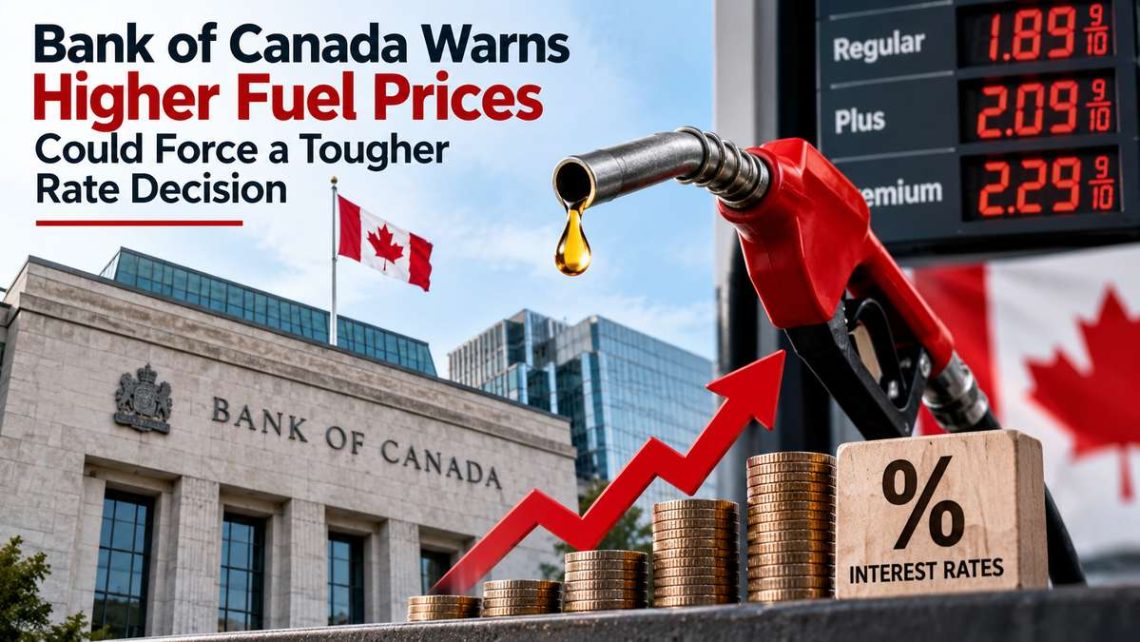
The Bank of Canada is keeping interest rates steady for now, but its latest policy discussions reveal growing concern that an extended surge in fuel prices could eventually force the central bank to tighten monetary policy.
Officials held the benchmark interest rate at 2.25% on September 2, leaving it unchanged for a seventh consecutive decision. But newly released minutes show that policymakers are watching closely for signs that higher gasoline and diesel prices are spreading into the broader economy.
The message is not that a rate increase has been decided.
Instead, the Bank is preparing for a situation in which a temporary energy shock begins turning into more persistent inflation.
That distinction could become increasingly important for Canadian households and businesses as the conflict in the Middle East continues to disrupt global energy markets.
Fuel Prices Are Becoming the Inflation Problem to Watch
Canada’s headline inflation rate has been running around 3% in recent months, with gasoline prices accounting for much of the increase.
The Bank’s September 2 statement said inflation excluding gasoline was 2.2% in July, while core inflation measures remained close to 2%. That suggests the immediate inflation pressure has been concentrated in energy rather than spreading broadly across the economy.
But policymakers are concerned about what happens if that changes.
The longer gasoline, diesel and oil prices remain elevated, the greater the possibility that businesses begin passing higher transportation and operating costs to consumers.
At that point, the problem would no longer be limited to the fuel pump.
The Spillover Effect Is the Critical Issue
Central bankers can generally look through some temporary price increases.
A sudden jump in gasoline caused by an external shock does not necessarily require an interest-rate response if it fades quickly and does not influence other prices.
The Bank of Canada’s latest deliberations show that officials are making precisely that distinction.
So far, they found little evidence that high gasoline prices were feeding significantly into other components of the consumer price index.
But officials agreed that the longer energy prices stay high, the greater the risk of broader pass-through. If that happens, the Bank said a monetary-policy response could become necessary to prevent more generalized inflation from taking hold.
That is the central warning emerging from the minutes.
The Middle East Conflict Is Complicating the Bank’s Job
The energy problem is linked to a geopolitical shock rather than overheating Canadian demand.
The Bank said the continuing Middle East conflict and reduced shipments through the Strait of Hormuz were keeping energy prices elevated. Refinery disruptions have also pushed refining margins higher.
This creates an uncomfortable situation for monetary policymakers.
Higher interest rates cannot increase global oil supplies or reopen disrupted shipping routes.
Yet if higher energy costs become embedded in wages, services and consumer prices, the central bank may have to respond to the inflationary consequences.
In other words, the Bank cannot solve the original problem—but it may eventually have to deal with what that problem does to Canadian inflation.
Canada’s Economy Is Not Running Hot
Another reason the decision is complicated is that Canada’s economy still has spare capacity.
The Bank’s officials judged that the economy remained in excess supply, while the labor market was relatively soft. That means weaker economic activity could help contain inflation by limiting businesses’ ability to raise prices.
That creates a difficult balancing act.
If the Bank raises rates too aggressively in response to an energy shock, it could add pressure to economic growth.
But if it waits too long while temporary energy inflation becomes broader and more persistent, restoring price stability could require stronger action later.
The latest deliberations show policymakers are trying to avoid either mistake.
Trade Tensions Add Another Layer
Fuel prices are not the only inflation risk facing Canada.
US tariffs and Canadian counter-tariffs are also increasing costs for some businesses.
The Bank said trade measures could eventually feed into consumer prices, while uncertainty surrounding US-Canada trade policy could weaken business confidence and investment.
This creates another policy dilemma.
Trade restrictions can raise prices while simultaneously slowing economic activity.
That combination is particularly difficult for a central bank because monetary policy has to consider both inflation and growth.
Officials acknowledged that weaker growth resulting from trade tensions could actually help contain some inflationary pressure.
But they also noted that tariffs can increase business costs that are eventually passed to consumers.
The September Rate Hold Was Not a Sign That Inflation Risks Have Disappeared
The decision to maintain the policy rate at 2.25% should therefore not be interpreted as a declaration that inflation is under control.
The Bank’s official statement said inflation had remained around 3% and that upside risks had increased because of energy prices and elevated refinery margins.
Governor Tiff Macklem also emphasized that the central bank was prepared to adjust monetary policy if necessary.
The message is essentially one of patience combined with vigilance.
Officials want more evidence before changing rates, particularly because the economy is still adjusting to trade uncertainty and other external shocks.
Households Could Feel the Effects in Two Directions
For Canadians, the situation has potentially conflicting consequences.
Higher fuel prices directly increase the cost of driving and transportation.
If those increases spread through the economy, households could also face higher prices for food, services and other goods.
But a future increase in interest rates would bring another set of pressures.
Borrowers with variable-rate loans could see higher payments, while businesses could face more expensive financing.
That means Canadians could experience the effects of the same energy shock through both higher prices and, eventually, tighter financial conditions if inflation becomes persistent.
Businesses Are Facing a Similar Squeeze
Companies are dealing with the same problem from another direction.
Fuel is a direct input for transportation, manufacturing, construction and many other industries.
Tariffs can add another layer of costs.
Some companies may absorb those increases to protect demand, while others may pass them to customers.
If enough businesses raise prices, an initially narrow energy shock can become a broader inflation problem.
That is precisely the spillover the Bank of Canada is monitoring.
The Bank Has a Narrower Path Ahead
The latest minutes reveal why the next few policy decisions could be unusually difficult.
On one side is inflation that has already been running above the Bank’s 2% target.
On the other is an economy that still has excess capacity and faces uncertainty from trade disputes.
Add an unpredictable energy shock, and the usual relationship between inflation and economic growth becomes harder to read.
The Bank therefore needs to determine whether higher fuel prices are simply pushing the headline inflation number temporarily higher or whether they are changing the way businesses and consumers set prices.
The Next Decision Will Depend on the Data
For now, policymakers have left the door open in both directions.
If energy prices fall and inflation outside gasoline remains contained, the case for leaving rates unchanged could remain strong.
If energy prices remain elevated and begin affecting a wider range of goods and services, the Bank has indicated that monetary policy may need to respond.
The next scheduled interest-rate decision is October 28, when the Bank will also release a new Monetary Policy Report.
That report could provide a clearer assessment of how officials see the energy shock, trade uncertainty and Canada’s economic recovery evolving.
The Bigger Risk Is Inflation Becoming Embedded
The most important message from the minutes is not that Canada is about to raise interest rates.
It is that policymakers are increasingly concerned about what could happen if today’s fuel-price shock lasts long enough to change tomorrow’s inflation expectations and pricing behavior.
For now, the Bank can look through much of the direct impact of higher gasoline prices.
But that approach has limits.
If fuel remains expensive for long enough, transportation costs rise, businesses adjust prices and workers respond to higher living costs, the original energy shock can become something much harder to reverse.
That is the scenario the Bank of Canada is preparing for.
For Canadian households, businesses and financial markets, the key number may therefore not be the price at the pump alone.
It will be whether those prices start showing up everywhere else.