A proposal to give Canada a new form of associate relationship with the European Union has quickly become the latest flashpoint in an increasingly complicated dispute between Washington and Brussels.
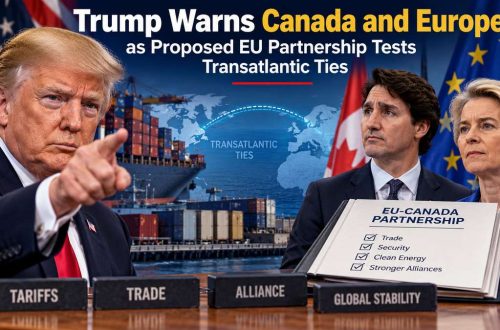
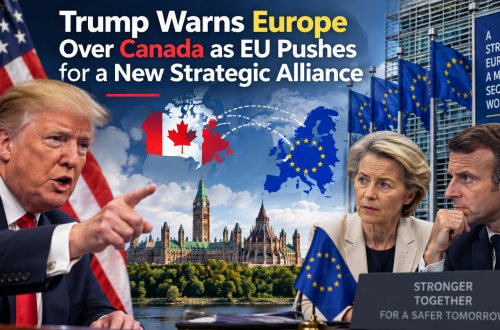
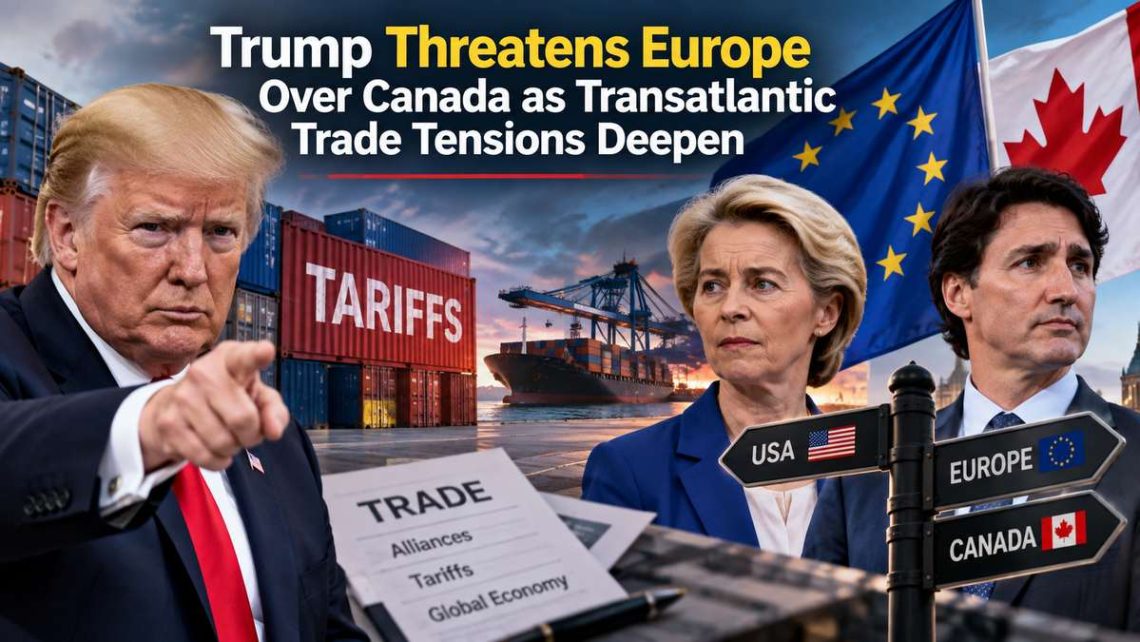
US President Donald Trump has warned that the United States could impose what he called “very serious tariffs” on the European Union, and potentially stop trading with Europe in some areas, if the bloc moves ahead with plans to make Canada its first associate member.
Trump dismissed the proposal as “laughable” and suggested that Washington could regard it as a hostile act depending on the intentions behind the move.
The warning came less than a day after European Commission President Ursula von der Leyen publicly proposed opening the door to Canada as the EU’s first associate member.
What might have been presented as a new economic partnership has therefore become part of a much larger debate about trade, sovereignty and the future shape of relations between North America and Europe.
Canada Is Not Joining the European Union
The language surrounding the proposal is important.
Canada is not applying for ordinary EU membership, and the bloc does not currently have a formal “associate member” category under its treaties.
Canadian Prime Minister Mark Carney has instead described Ottawa’s goal as a “unique alliance” with Europe.
The proposed arrangement would seek deeper cooperation while keeping Canada outside the EU’s political institutions. Reuters reported that such a framework would be unprecedented and could raise significant legal questions for the 27 EU member states.
That makes the proposal less like traditional EU enlargement and more like an attempt to create a new model for strategic partnership.
Why Canada Wants Europe Closer
Canada’s interest in Europe comes at a time when its traditionally close relationship with the United States has become more difficult.
Washington remains Canada’s most important trading partner, but tariffs, trade disputes and repeated political tensions have encouraged Ottawa to look for additional economic options.
Carney has been seeking stronger links with Europe and has spoken about building Canada’s trade beyond its heavy dependence on the US market.
For Canada, the European relationship could provide access to a large market while also creating new partnerships in industries that are increasingly important to national security.
The objective is not necessarily to replace the United States.
It is to have more alternatives.
Europe Sees Canada as More Than a Trade Partner
The EU’s interest goes beyond buying and selling goods.
Von der Leyen has proposed an “Alliance for the Future” involving cooperation in manufacturing, technology, defense, energy, critical minerals, artificial intelligence, cybersecurity and the Arctic.
Those sectors have become increasingly important as governments attempt to secure supply chains and reduce strategic vulnerabilities.
Canada’s natural resources and Arctic position make it particularly relevant to Europe’s long-term economic and security planning.
The proposal could therefore create a relationship that reaches far beyond the traditional boundaries of a trade agreement.
The Existing CETA Agreement Is Already in Place
Canada and the EU already have a major trade framework: the Comprehensive Economic and Trade Agreement, or CETA.
The proposed associate relationship would build on those existing ties rather than create the first economic connection between the two sides.
However, CETA itself illustrates how complicated European trade arrangements can become.
The agreement has been provisionally applied for years, but not every EU member state has completed the full ratification process.
Creating a broader partnership could therefore require substantial political and legal negotiations.
Trump’s Warning Changes the Calculation
Trump’s reaction adds another layer of uncertainty.
He said that if the EU’s move were made with what he regarded as a hostile intention, the United States could respond with heavy tariffs or restrictions on trade with Europe.
But there is an important distinction between a threat and an implemented policy.
No new US tariff or general trade cutoff against the EU has been imposed as a direct result of this proposal. Trump’s comments describe possible future action.
That leaves Brussels and Ottawa facing a political calculation rather than an immediate change in customs rules.
Brussels Says the Partnership Is Not Anti-American
European officials have rejected the idea that closer cooperation with Canada is intended to target the United States.
Von der Leyen has described the initiative as being about the EU’s “common strength,” rather than a partnership against another country.
A European Commission spokesperson reiterated that position after Trump’s comments.
That distinction will be important if negotiations continue.
Europe maintains extensive economic and security ties with Washington, and the EU has little interest in turning every new partnership into a confrontation with the United States.
At the same time, European officials have increasingly argued that the bloc needs greater capacity to make independent economic and strategic decisions.
France Pushes Back Against the Idea of a US Veto
The dispute has already produced a response from France.
French European Affairs Minister Benjamin Haddad said the United States does not have the authority to determine Europe’s political or geopolitical direction.
His comments underline the tension at the heart of the dispute: Washington views the proposed Canada-EU relationship through the lens of US interests, while European governments see it as a decision for the EU and its member states.
That disagreement could become more significant if the proposal moves from political discussion to formal negotiations.
The Arctic Adds Strategic Weight
The Arctic is one of the less obvious reasons the Canada-EU relationship matters.
Canada is a major Arctic country, while Europe has growing strategic interests in the region.
Climate change is opening new shipping possibilities, while competition over natural resources, critical minerals and security is making the Arctic increasingly important.
Closer Canadian-European cooperation could give both sides greater influence over issues ranging from infrastructure and energy to environmental monitoring and security.
It also gives Europe a relationship with a country that occupies a central position in the northern Atlantic and Arctic regions.
Defense Cooperation Is Also Expanding
The proposed partnership includes defense industry cooperation, another sign that the relationship is not simply about trade.
Canada has already become involved in European defense procurement initiatives, and Ottawa and European capitals have been discussing deeper cooperation.
That could eventually involve industrial supply chains, military technology and strategic production.
For Canada, closer European defense links could complement its existing NATO commitments.
For Europe, Canadian participation could add industrial capacity and strengthen cooperation with another NATO ally.
A New Test for the Transatlantic Relationship
The dispute raises a difficult question for all three sides.
Can Canada deepen its relationship with Europe without triggering a larger confrontation with Washington?
And can Europe expand its strategic partnerships without turning economic diversification into another source of transatlantic trade conflict?
There are no simple answers.
Canada remains deeply connected to the US economy. Europe remains an important US economic and security partner. Yet both Canada and the EU are simultaneously looking for ways to reduce vulnerabilities and build greater strategic flexibility.
That creates overlapping interests—and potential friction.
The Proposal Still Has a Long Way to Go
For all the political attention surrounding the announcement, Canada has not become an associate member.
The concept itself does not currently exist as a defined status in EU treaties.
Any formal arrangement would need to be negotiated and supported by EU member states, with difficult questions about market access, regulations, institutional participation and legal obligations still unresolved.
Canada would also need to determine how much integration it actually wants.
Closer access to European markets could create economic opportunities, but deeper regulatory alignment could also impose new obligations.
Carney’s European Mission Takes on Greater Importance
Canadian Prime Minister Mark Carney is scheduled to address the European Parliament as the debate unfolds.
His message will be closely watched because Ottawa needs to demonstrate that its European strategy is about strengthening Canada’s economic and strategic options rather than simply reacting to Washington.
For Europe, the visit offers an opportunity to show that it can build new partnerships while maintaining its existing international relationships.
For the United States, the episode is another reminder that its allies and neighbors are increasingly examining alternative economic arrangements.
A Bigger Shift Than One Membership Proposal
The immediate dispute may be about Canada’s possible associate status.
The larger story is about the changing architecture of Western economic relationships.
Canada is trying to diversify.
Europe is seeking greater strategic resilience.
Washington is making clear that it will closely scrutinize those moves when they affect US economic interests.
Whether the EU ultimately creates an associate relationship with Canada remains uncertain. But the proposal has already exposed a deeper question: how much freedom should allies have to build new economic and security partnerships when those partnerships may change the balance of influence within the transatlantic system?
The answer will not be determined by one speech or one tariff threat.
It will emerge through negotiations between Canada and Europe—and through the broader choices Washington, Brussels and Ottawa make about trade, security and strategic independence in the years ahead.