A proposed new relationship between Canada and the European Union has quickly become the latest source of tension between Brussels and Washington.
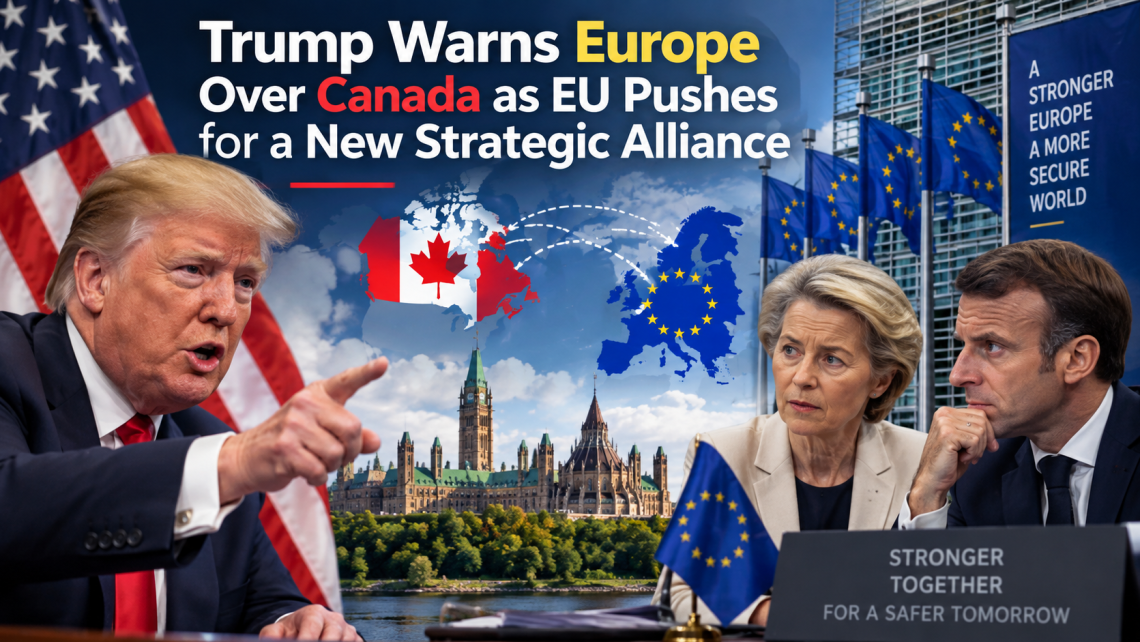
US President Donald Trump has warned that the United States could impose “very serious tariffs” on the European Union, and potentially restrict trade in a number of areas, if the bloc moves ahead with a plan to make Canada its first associate member.
Trump described the proposal as “laughable” and said Washington would respond differently depending on whether it believed the initiative was friendly or hostile toward the United States.
The comments came a day after European Commission President Ursula von der Leyen proposed opening the door to a new form of associate membership for Canada during her annual State of the Union address.
The episode is quickly becoming about much more than Canada’s relationship with Europe. It is exposing a larger debate over trade, strategic autonomy and the future of the transatlantic partnership.
Canada Is Not Becoming an EU Member
The first point to clarify is that Canada is not joining the European Union.
The EU currently has no established legal category called “associate membership,” meaning von der Leyen’s proposal would require a new framework.
She did not provide detailed terms for the proposed status, and EU member states would ultimately have to approve any move forward. Reuters reported that some EU officials were uncertain about what associate membership would actually mean.
Canadian Prime Minister Mark Carney welcomed the broader idea of a deeper alliance with Europe but did not specifically endorse the associate-member label in his initial response.
That leaves considerable room for negotiation.
Why Brussels Wants a Closer Relationship With Ottawa
Von der Leyen’s proposal comes as Europe looks for stronger partnerships in an increasingly uncertain international environment.
In her speech, she said the EU and Canada should move beyond their existing trade relationship toward what she called an “Alliance for the Future.”
The proposed cooperation could cover advanced manufacturing, technology, defense industries, the Arctic, energy, critical minerals, batteries, artificial intelligence, quantum technology, cybersecurity and economic security.
That is considerably broader than a conventional trade agreement.
The goal would be to build stronger economic and strategic connections between two partners that already cooperate closely on several international issues.
CETA Already Gives Them a Starting Point
Canada and the EU already have a substantial economic relationship through the Comprehensive Economic and Trade Agreement, or CETA.
Von der Leyen said trade in goods between the two sides had grown by 75% in less than a decade under the agreement.
The proposed next stage would therefore build on an existing foundation rather than create a relationship from scratch.
The challenge is determining what additional rights and obligations an associate relationship would provide.
Would Canada gain access to more European programs? Would it participate in selected EU initiatives? Would regulatory alignment become deeper?
Those details remain unanswered.
Canada’s Search for More Economic Options
The proposal comes at a difficult moment in Canada-US relations.
Canada remains heavily dependent on the US market, but trade tensions have increased since Trump’s return to the White House.
Carney has previously said he wants Canada to substantially expand its non-US trade over the next decade.
Closer European ties could help Ottawa diversify its economic relationships while maintaining its existing links with Washington.
The objective would not necessarily be to replace the United States.
Instead, Canada would have more options.
Trump Sees a Potential Challenge
Trump’s response shows why the proposal is politically sensitive.
He said that if the EU’s move were considered a hostile act, he could impose heavy tariffs or “stop trading with Europe on many things.” He also distinguished between what he described as good and bad intentions behind the proposal.
There is an important difference between this warning and an implemented trade measure.
The United States has not imposed a new general tariff on the EU as a direct result of the Canada proposal. Trump’s comments describe possible future action if Washington decides the initiative threatens US interests.
That leaves considerable uncertainty over what might happen next.
Brussels Rejects the Idea of an Anti-US Alliance
The European Commission has pushed back against the suggestion that closer relations with Canada are designed to confront the United States.
Commission spokesperson Olof Gill said the proposed strengthening of the EU-Canada partnership was “not against anyone else” but intended to build common strength.
That position is consistent with von der Leyen’s own speech.
She presented the Canada initiative as part of Europe’s effort to build resilience and strengthen cooperation among democracies rather than as an anti-American project.
Whether Washington accepts that explanation is another matter.
France Says Washington Cannot Choose Europe’s Direction
France has already responded strongly to Trump’s warning.
French Europe Minister Benjamin Haddad said the United States does not have the power to determine Europe’s political or geopolitical direction.
His comments underline the central disagreement emerging from the dispute: Washington can decide how it responds to European policies, but Brussels argues that the EU itself has the right to determine its partnerships.
That tension could become more important if the associate-membership proposal moves toward formal negotiations.
The Arctic Gives the Partnership Extra Weight
The proposed relationship also has a strategic dimension that extends beyond trade.
Canada’s Arctic position makes it particularly important to European governments as the region becomes more significant for security, transportation, energy and critical resources.
Von der Leyen specifically proposed making the Arctic a flagship area of joint cooperation.
The EU and Canada also want to work more closely on critical minerals and batteries, areas where governments are increasingly focused on secure supply chains.
Defense Cooperation Could Become Another Pillar
Defense is another important part of the proposal.
Von der Leyen called for closer integration between European and Canadian defense industries.
That could mean deeper cooperation on production, technology and supply chains, while remaining compatible with NATO commitments.
For Europe, Canadian involvement could add industrial and strategic capacity.
For Canada, stronger European defense links could provide another layer of cooperation alongside its existing relationship with the United States and NATO.
Some Europeans Are Unsure About the Idea
The proposal has not received universal enthusiasm within Europe.
One EU diplomat cited by Reuters said there was uncertainty about what associate membership would mean and questioned whether the European Commission was promising more than it could ultimately deliver.
That skepticism points to a practical problem.
Creating a new category of relationship is politically attractive, but turning it into a workable legal framework could take considerable time.
The 27 EU governments would need to agree on the terms, while Canada would have to decide how closely it wants to align with European rules and institutions.
A Test of Strategic Autonomy
The dispute may ultimately be less about membership than about strategic autonomy.
Europe is attempting to build stronger economic and security relationships with partners outside the traditional EU framework.
Canada is seeking greater diversification as its relationship with Washington becomes more complicated.
The United States, meanwhile, remains the dominant economic and security partner for both Canada and many European countries.
Those realities overlap—and sometimes collide.
What Happens Next?
Carney’s address to the European Parliament is expected to provide more insight into Canada’s vision for the relationship.
The immediate challenge will be turning von der Leyen’s political proposal into something concrete.
That means answering basic questions about market access, regulation, security cooperation, institutional participation and legal status.
At the same time, Canada and Europe will have to consider how far they can deepen their relationship without creating additional trade friction with Washington.
More Than a Dispute Over Canada
Trump’s “laughable” description has given the story a dramatic headline, but the underlying issue is more consequential than the exchange of political comments.
Canada and Europe are exploring whether they can create a deeper economic and strategic partnership at a time when the traditional assumptions of the transatlantic relationship are being tested.
The proposed associate membership is still only an idea.
But if it develops into a formal framework, it could establish a new model for how the EU works with strategically important countries outside its borders.
For Canada, it could provide another route to economic diversification.
For Europe, it could strengthen cooperation in technology, defense, resources and the Arctic.
And for Washington, it raises a larger question about how its allies and neighbors will respond as they seek greater room to make independent economic and geopolitical choices.
The next stage will not be decided by Trump’s warning alone. It will depend on whether Canada and the EU can turn an ambitious political proposal into a workable partnership—and how Washington chooses to respond.