A new dispute between Washington and Brussels is putting Canada at the center of an increasingly complicated transatlantic trade relationship.
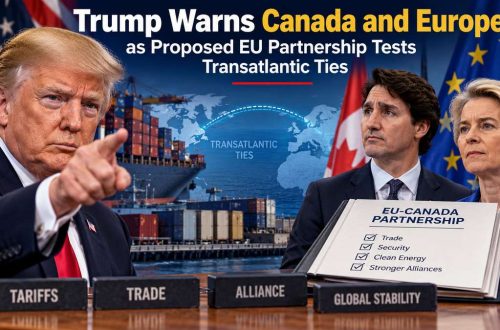
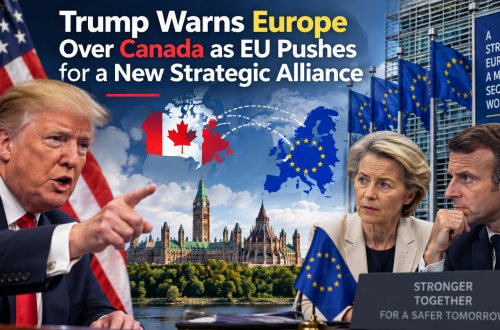
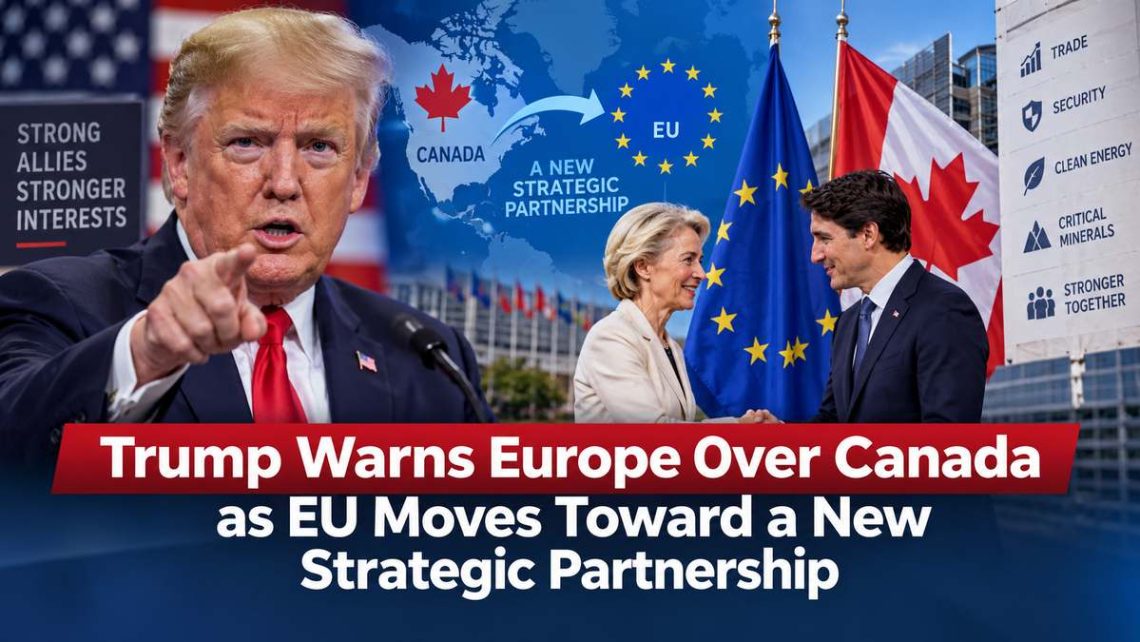
US President Donald Trump has threatened the European Union with “very serious tariffs” and even a possible halt to trade in some areas if the bloc moves ahead with plans to deepen its relationship with Canada.
Trump dismissed the idea of Canada becoming an EU “associate member” as “laughable” and suggested the move could be considered hostile to the United States, depending on the intentions behind it.
The threat came just hours after European Commission President Ursula von der Leyen proposed opening the door for Canada to become the EU’s first-ever associate member.
The dispute is therefore about more than an unusual European membership proposal. It highlights how Canada, Europe and the United States are reconsidering economic and strategic relationships at a time when traditional alliances are under increasing pressure.
Canada Is Not Seeking Full EU Membership
One of the most important details is that Canada is not seeking to become a full member of the European Union.
The proposed associate status would be a new arrangement because the EU currently has no formal category of “associate membership” under its treaties.
Instead, the idea is to create a much closer partnership covering areas such as trade, defense, technology, energy, critical minerals, batteries, cybersecurity and Arctic cooperation.
Canadian officials have also indicated that Ottawa wants a relationship that strengthens Canadian sovereignty rather than requiring the country to surrender elements of it, as full EU membership would involve.
That distinction makes Trump’s characterization of the proposal as Canada “joining” the EU misleading.
Why Canada Is Looking More Closely at Europe
The proposal comes after a significant deterioration in relations between Ottawa and Washington.
Canada remains deeply integrated with the US economy, but Trump’s tariff policies and repeated pressure on Canada’s economic relationship with the United States have encouraged Ottawa to look for additional trading and strategic partners.
Canada has been seeking what Prime Minister Mark Carney has described as a “unique alliance” with Europe.
The goal is not necessarily to replace the United States, but to reduce Canada’s dependence on a single market and create additional options for trade, investment and strategic cooperation.
That calculation is particularly important because the United States remains Canada’s overwhelmingly dominant export destination.
Europe Sees an Opportunity Too
For the EU, closer ties with Canada offer advantages beyond traditional trade.
Von der Leyen’s proposal came as Europe seeks stronger partnerships in defense, energy and critical technologies while dealing with geopolitical uncertainty involving Russia, China and the United States.
The European Commission has identified cooperation with Canada in areas including critical minerals, batteries, quantum technology, cybersecurity, energy, defense industries and the Arctic.
Canada also has resources and industrial capabilities that could help Europe diversify supply chains.
The relationship could therefore develop into something much broader than another trade agreement.
Existing Trade Ties Already Provide a Foundation
Canada and the EU are not starting from zero.
They already have the Comprehensive Economic and Trade Agreement, commonly known as CETA.
The proposed new relationship would build on that existing framework rather than replace it.
That is significant because some European governments have reportedly questioned whether a completely new preferential trade arrangement is necessary when CETA has not yet been fully ratified across all EU member states.
The debate therefore involves both political ambition and practical questions about how much additional economic integration is possible.
Trump Links the Proposal to US Interests
Trump’s response has turned what might otherwise have been a European-Canadian policy discussion into a transatlantic dispute.
Speaking to reporters after arriving in North Carolina, Trump said that if the EU’s move were considered a hostile act, the United States could impose heavy tariffs or stop trading with Europe in some areas.
He also criticized Canada as a “terrible trade partner” and described the prospect of associate membership as “laughable.”
However, Trump did not announce a specific new tariff rate or an immediate suspension of trade.
His warning was conditional on how Washington interprets the EU’s intentions.
That distinction matters because the comments represent a threat of possible future action rather than a new tariff measure already in force.
Brussels Says the Partnership Is Not Directed Against Washington
The European Commission has pushed back against the idea that closer ties with Canada are intended as an anti-American move.
A Commission spokesperson said the proposed strengthening of the EU-Canada relationship was not directed against anyone, but was intended to increase the partners’ collective strength.
That message reflects Europe’s difficult position.
The EU has strong economic and security links with the United States, but European governments are also attempting to build greater strategic resilience and reduce vulnerabilities in critical sectors.
Canada fits naturally into that strategy because of its geographic position, natural resources, industrial base and existing ties with European countries.
Carney Faces a New Diplomatic Test
Canadian Prime Minister Mark Carney’s appearance at the European Parliament comes at a sensitive moment.
He has been advocating closer economic and security cooperation with Europe, while his government simultaneously has to manage Canada’s highly important relationship with Washington.
For Ottawa, the challenge is balancing these relationships without turning diversification into an open confrontation with its largest trading partner.
The European Parliament’s reception of Carney could provide a clearer indication of how far both sides want to take the proposed partnership.
The Arctic Could Become a Major Part of the Relationship
One of the less obvious elements of the emerging EU-Canada relationship is the Arctic.
Canada is one of the world’s major Arctic states, while Europe has growing strategic and economic interests in the region.
Climate change, shipping routes, energy resources, critical minerals and security concerns are making the Arctic increasingly important to governments on both sides of the Atlantic.
Closer Canadian-European cooperation could therefore extend well beyond conventional trade.
The same is true of critical minerals and battery supply chains, where both Canada and Europe have incentives to develop alternatives to concentrated supply sources.
A New Model for Alliances?
The debate over associate membership could eventually become a test case for a different kind of international partnership.
Canada does not need to become an EU member to cooperate more closely with European governments.
Likewise, the EU does not necessarily need to expand its borders to build deeper economic and security relationships with countries that share many of its interests.
A flexible partnership could potentially cover trade, technology, defense, energy and mobility while allowing Canada to remain outside the EU’s political institutions.
But creating such a model would require negotiations over rules, market access, regulatory standards and the division of responsibilities.
Trade Tensions Could Make the Proposal More Difficult
The immediate problem is that the proposal has arrived during an already tense period in US-EU trade relations.
Washington and Brussels have spent years negotiating tariffs and market access, while Canada is also dealing with US trade pressure.
Adding a new Canada-EU arrangement could complicate those negotiations further.
For businesses, uncertainty may become a bigger concern than the political language itself.
Companies operating across North America and Europe need clarity over tariffs, supply chains and regulatory requirements. New barriers could increase costs even if governments ultimately avoid a broader trade confrontation.
Canada’s European Pivot Is About Options
The emerging dispute ultimately reveals something larger than Trump’s reaction to an unusual EU proposal.
Canada is trying to create more economic and strategic options.
Europe is looking for stronger partnerships outside traditional frameworks.
And Washington is making clear that it is closely watching how its allies build those relationships.
Whether Canada eventually receives some form of associate status remains uncertain, because the concept itself would need to be developed and negotiated.
But the debate has already demonstrated how quickly a European-Canadian initiative can become part of a much larger argument about trade, sovereignty and the future shape of Western alliances.
The central question is no longer simply whether Canada can move closer to Europe.
It is how far that relationship can develop without triggering another major confrontation with Canada’s most important economic partner.