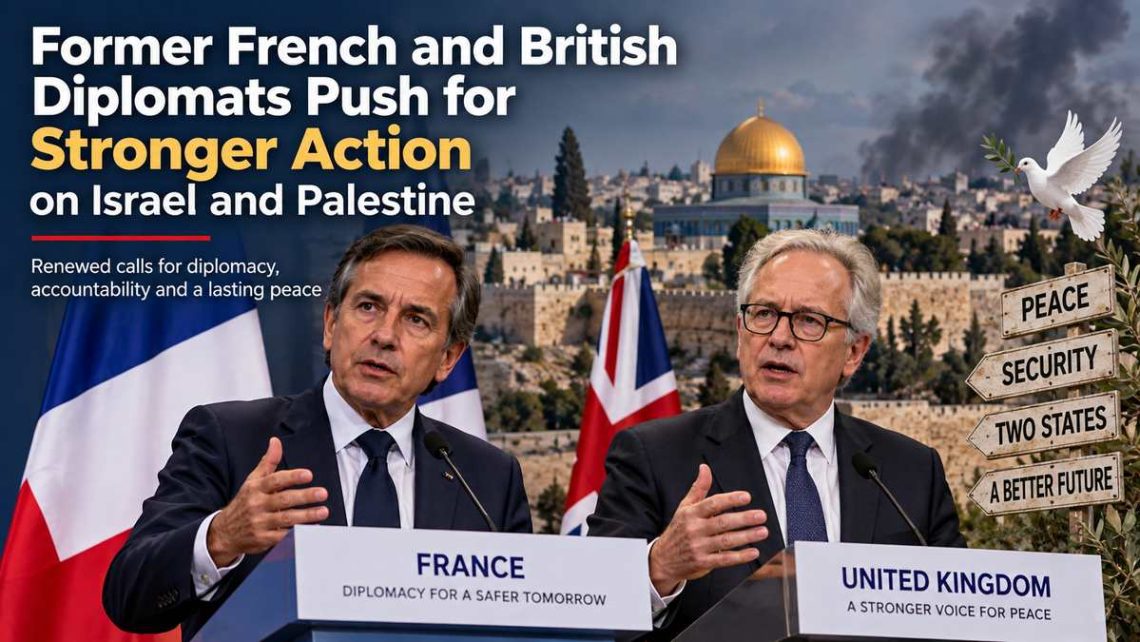
More than 100 former French and British diplomats are calling for a tougher response to Israel’s policies toward Palestinians, arguing that repeated statements of concern have done little to change conditions on the ground.
In a joint open letter published in France, 102 former diplomats from the two countries urged their governments to move beyond diplomatic criticism and introduce concrete economic and military measures against Israel. Their proposals include suspending trade arrangements, stopping arms transfers and restricting commercial activity linked to Israeli settlements in the occupied Palestinian territories.
The intervention comes as international pressure over Gaza and Israeli settlement expansion in the occupied West Bank continues to grow.
But the letter also raises a broader question for European governments: what happens when diplomatic condemnation is not followed by policy changes?
Former Diplomats Call for Action, Not Statements
The signatories include former ambassadors and senior diplomats with experience in the Middle East, the United Nations and other international postings.
Among them are former British ambassadors Jeremy Greenstock and Emyr Jones Parry, as well as former French Middle East officials Yves Aubin de la Messuziere and Denis Bauchard.
Their argument is straightforward. France and the UK have repeatedly criticized Israeli actions and expressed support for Palestinian statehood, but the former diplomats say stronger measures are now necessary.
The letter calls for both governments to work together to uphold international law and support equal rights for Israelis and Palestinians.
The signatories specifically want France and Britain to suspend their respective trade arrangements with Israel and halt arms transfers and military cooperation.
Settlement Expansion Is a Central Concern
A major focus of the letter is Israel’s continued settlement activity in the occupied West Bank.
The former diplomats argue that expansion of settlements could make the creation of a viable Palestinian state increasingly difficult.
Their concerns come amid renewed attention to the proposed E1 settlement area, a strategically important stretch of land between East Jerusalem and the larger West Bank settlement bloc of Ma’ale Adumim.
Critics of the project argue that development in the area could fragment Palestinian territory and make a contiguous future Palestinian state harder to establish. Western governments have also warned businesses about potential legal and reputational consequences associated with involvement in settlement construction.
For the former diplomats, settlement expansion is therefore not simply a local planning dispute. They view it as part of a larger political question about whether a two-state settlement remains possible.
What Would the Proposed Measures Actually Do?
The letter contains a wide-ranging list of proposed measures.
Among them are:
- Suspending the EU-Israel trade agreement and Britain’s bilateral trade arrangement with Israel.
- Halting arms transfers and military cooperation.
- Banning trade connected to Israeli settlements.
- Restricting property purchases by citizens in Israeli settlements in occupied Palestinian territory.
- Removing charitable status from organizations that financially support settlements.
- Expanding humanitarian access to Gaza.
- Supporting UN agencies involved in humanitarian assistance.
- Protecting access for journalists, diplomats and parliamentarians.
These are significant proposals, but they remain recommendations from former diplomats, rather than policies automatically adopted by either government.
That distinction is important.
France and Britain Have Already Recognized Palestine
The former diplomats’ demands also build on a major policy step already taken by France and the UK.
Both countries recognized the State of Palestine in 2025. The signatories argue that recognition should be accompanied by practical measures intended to protect Palestinian self-determination.
Their argument effectively shifts the debate from recognition to implementation.
If European governments formally support Palestinian statehood, the former officials ask, what policies should follow when developments on the ground appear to threaten the possibility of such a state?
That question is likely to remain at the center of European discussions over Israel and Palestine.
The Gaza War Remains Part of the Pressure
The diplomatic intervention also comes against the backdrop of the continuing humanitarian crisis in Gaza.
According to figures cited by Al Jazeera from Gaza’s Ministry of Health, more than 72,000 Palestinians had been killed since the war began in October 2023. The same report said that at least 1,285 Palestinians had been killed since a ceasefire that began in October 2025.
Those figures are provided by Gaza’s Ministry of Health and are cited here as reported rather than independently verified.
The former diplomats are calling for expanded humanitarian access and continued support for United Nations agencies operating in Gaza.
Their position is that humanitarian assistance should not be treated separately from wider diplomatic policy.
The Former Officials Are Also Looking at European Responsibility
Another distinctive feature of the letter is its emphasis on Britain’s and France’s historical roles in the region.
The signatories point to the mandates administered by Britain and France after World War I and argue that both countries therefore have a particular responsibility to uphold international law and address the consequences of decisions made in the region’s modern political history.
That argument adds a historical dimension to what is otherwise a contemporary policy debate.
The diplomats are effectively saying that European governments cannot claim neutrality while maintaining economic, military and diplomatic relationships with a government whose policies they simultaneously criticize.
Israel Has Faced Growing International Pressure
The letter comes amid broader international disagreement over Israeli settlement policy and the war in Gaza.
Western governments have increasingly issued warnings over settlement expansion, including concerns about the E1 project.
In August, a group of Western governments and the European Commission warned companies about participating in construction tenders connected to E1, arguing that the development could undermine the territorial continuity needed for a two-state solution.
The former diplomats are asking governments to go further by introducing measures that would create direct economic consequences.
That would represent a significant shift from diplomatic statements toward economic pressure.
The United States Remains a Major Factor
The former diplomats also acknowledge that European pressure alone may have limited influence.
One of the signatories, former British ambassador Nicholas Hopton, told Al Jazeera that the United States remains the country with the greatest influence over Israeli government decisions.
That observation highlights one of the central difficulties facing European governments.
France and Britain can change their own trade, military and diplomatic policies, but their ability to alter the broader conflict depends partly on how those measures interact with US policy and the positions of other major international actors.
A Debate Over Pressure Versus Diplomacy
The letter illustrates a growing debate over whether traditional diplomacy is enough to influence the conflict.
Supporters of stronger measures argue that criticism without consequences risks having little practical effect.
Others may question whether sanctions, trade restrictions or limits on military cooperation would produce the desired political outcome or make diplomatic engagement more difficult.
Those questions remain unresolved.
What is clear is that the former diplomats are asking their governments to reconsider the balance between maintaining established relationships and using economic and diplomatic leverage.
The Bigger Issue Is What Comes After Recognition
The most significant part of the intervention may not be the number of former diplomats involved, but the policy question they are putting before France and Britain.
Recognition of Palestine was a major diplomatic step. The former officials now argue that recognition needs to be accompanied by measures capable of protecting the conditions necessary for Palestinian self-determination.
Whether London and Paris adopt any of those proposals is ultimately a decision for their governments.
For now, the letter demonstrates that the debate inside European foreign-policy circles is moving beyond whether to criticize Israeli policies and toward a harder question: what practical costs, if any, should follow when governments believe international law or established diplomatic commitments are being violated?
That question places trade, arms sales, settlements and humanitarian access at the center of the next stage of the European debate over Israel and Palestine.