For many emerging filmmakers, making a good film is only half the battle. The harder part can be finding the money, mentorship and industry connections needed to take that film beyond its home market.
A new partnership between Nairobi-based DOCUBOX and the French Embassy in Kenya is attempting to address exactly that gap.
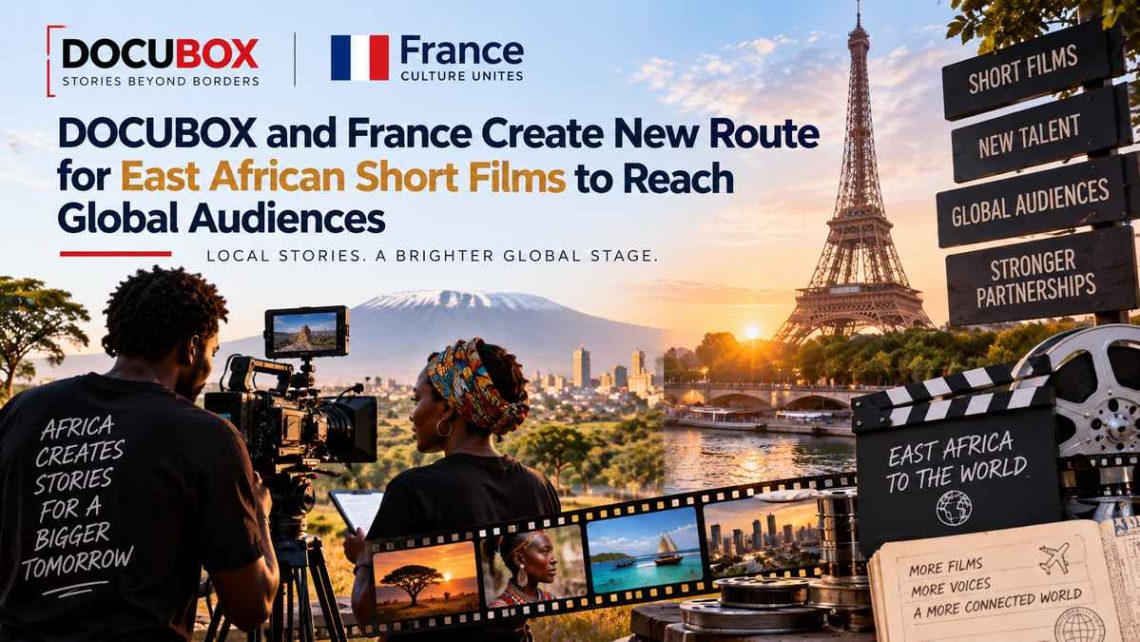
The organizations have launched the East African Short Fiction Development Grant, a program designed to help writers and directors develop short fiction projects and introduce them to international film professionals at the Clermont-Ferrand International Short Film Festival and Market in France.
Rather than focusing only on production funding, the initiative combines financial support with script development, pitching skills and direct access to an international film market.
That combination could prove particularly important for filmmakers whose biggest challenge is not finding a story, but finding the right people to help that story travel.
Five Filmmakers Will Receive Support
The program will select five East African writers and directors who are currently developing short fiction projects.
Each selected filmmaker will receive a €2,500 development grant, along with three months of online mentorship covering areas such as scriptwriting, story development and pitching.
The program will then take the participants further into the international industry through three days of training, pitching opportunities and professional networking at Clermont-Ferrand.
Applications are currently open, with the deadline set for September 20, 2026.
Applicants must have written or directed at least two short films or audiovisual works, with previous work screened at festivals, cinemas, television or video-on-demand platforms.
They must also have a short fiction project currently in development.
Why the Clermont-Ferrand Connection Matters
The choice of destination is central to the program.
Clermont-Ferrand is one of the world’s most important meeting points for short filmmaking. For an emerging filmmaker, attending such a market can provide opportunities that are difficult to recreate from home.
A filmmaker may have a compelling script, for example, but that does not automatically lead to international financing or distribution.
A pitch meeting with a producer, festival programmer or potential co-production partner can change that equation.
The DOCUBOX-France initiative is therefore treating international exposure as part of the development process rather than something that happens after a film is finished.
That is an important distinction.
Moving Beyond the Funding Model
Film grants are valuable, but money alone does not guarantee that a project will find an audience.
A filmmaker may receive enough funding to improve a script while still lacking the industry knowledge to explain the project’s potential to international partners.
The new program attempts to address both problems at once.
The mentorship component gives participants time to strengthen their stories, while the Clermont-Ferrand experience provides an opportunity to learn how the international film business operates.
In practical terms, filmmakers are being prepared not just to make films, but to present those films to the people who can help finance, produce, distribute and showcase them.
DOCUBOX Brings Regional Experience
The partnership also builds on DOCUBOX’s existing work with East African filmmakers.
Founded in 2013 by filmmakers, DOCUBOX describes its mission as supporting talented East African filmmakers and helping independent African films reach audiences in the region and internationally. Its current platform says the organization has supported more than 40 feature documentaries, 80 short fiction films and 50 short documentaries.
That existing network gives the new initiative a regional foundation.
Instead of creating an international opportunity without local context, the program connects an established East African filmmaking organization with a major European short-film market.
France Is Expanding Its Creative-Industry Links in East Africa
The initiative also reflects France’s broader cultural engagement with Kenya and the wider East African creative economy.
French-Kenyan cooperation already extends into areas such as business, development and cultural exchange. France describes Kenya as an important regional hub for access to East African markets, while French companies and institutions maintain a significant presence in the country.
Kenya’s government has also highlighted growing international interest in the country’s audiovisual sector.
In March 2026, Kenya’s Ministry of Information, Communications and the Digital Economy said international production interests were exploring opportunities to document African cultures and communities, while emphasizing opportunities for young creatives.
The new film initiative fits naturally into that wider environment.
A Chance to Reduce the Geography Problem
For filmmakers in East Africa, geography can become an invisible barrier.
International film festivals and markets can be expensive to attend. Travel, accommodation, accreditation and professional networking all require resources that emerging filmmakers may not have.
As a result, talented creators can remain outside the conversations where international partnerships are formed.
This program directly addresses part of that problem by supporting participation at Clermont-Ferrand.
That matters because international film industries often operate through relationships. A script can open the door, but personal meetings, introductions and repeated professional contacts can determine whether a project moves forward.
The Goal Is More Than Festival Exposure
It would be easy to describe the initiative simply as a route for East African films into European festivals.
Its potential reach is broader.
The organizers say the program is intended to help filmmakers connect with international buyers and co-production opportunities, while developing the creative and business skills needed to pitch projects effectively.
That means success could be measured not only by whether a project screens at a festival, but by whether filmmakers build relationships that remain useful after the program ends.
For a young director, meeting a producer who later helps finance a first feature could be far more significant than a single festival appearance.
East African Stories Are Getting More International Attention
The timing also reflects a wider increase in international interest in African cinema.
East African projects have increasingly appeared in major festival and market programs, giving filmmakers opportunities to tell stories rooted in local experiences to international audiences.
Recent East African projects have featured at events such as the Red Sea International Film Festival and its industry market, where Kenyan, Ugandan and other regional productions have been presented alongside international projects.
The challenge now is building stronger pathways from promising projects to sustainable careers.
That requires more than occasional festival selections.
It requires financing, training, professional networks and access to decision-makers.
Building a Pipeline, Not Just a One-Time Opportunity
The most interesting aspect of the DOCUBOX-France partnership may therefore be its potential to create a pipeline.
A filmmaker enters with a project in development.
The grant provides resources to strengthen it.
Mentorship improves the script and pitch.
Industry training prepares the creator for professional conversations.
And the Clermont-Ferrand market provides a setting where those conversations can actually happen.
Each stage addresses a different obstacle.
That makes the initiative less like a traditional grant and more like a bridge between East African creative talent and the international film economy.
What Comes Next for the Selected Filmmakers?
The immediate focus is on applications ahead of the September 20 deadline.
But the larger test will come afterward.
The real impact will depend on what happens to the five selected projects once the Clermont-Ferrand experience is over.
Will they attract co-producers? Secure additional financing? Reach international festivals? Lead their creators toward longer-form projects?
Those outcomes will determine whether the initiative becomes simply another development program or a meaningful route into the global industry.
For now, however, the partnership sends a clear message: East African filmmakers do not only need platforms to show completed films. They also need access to the international networks that can help those films get made in the first place.
By connecting local storytelling talent with development support and one of the world’s major short-film markets, DOCUBOX and France in Kenya are trying to close that gap.
And for five filmmakers, the opportunity could begin with something as simple—and as difficult—as getting the right story in front of the right people.